
Table of contents
%20Logo.svg)
- Hareesh Vemasani & Rohith Jarugu
- Bangalore, India
- Business started in 2024
- 3 Employees
- 4K MRR in USD
- 300 paid subscribers (SaaS)
- 30,000 website visitors per month
- Bootstrapped
- ResumeUp.AI
Hareesh what's your backstory?
II'm Hareesh Vemasani, co-founder of ResumeUp.AI. I grew up in the southern part of India, where the "safe path" was the default: study well, get a job, don’t take unnecessary risks - and my path into startups wasn’t the typical “I always wanted to be a founder” story.
Before becoming a founder, I worked as a software professional and spent years building scalable software applications, working with MNCs and startups. During that time, I also developed a strong interest in SEO almost by accident. I started a few blogs on the side, mostly as an experiment, and was able to grow a couple of those blogs to 200,000+ monthly users.
That experience changed how I think. Watching something you built bring in real users every day is addictive - and it gave me the confidence that I could build and grow products, not just code features.
It also made me hungry to do something bigger than blogs: something that has a clear outcome for users and makes a real difference in their lives.
That’s what pushed me into founder life.

What does ResumeUp.ai do, and how did you come up with the idea?
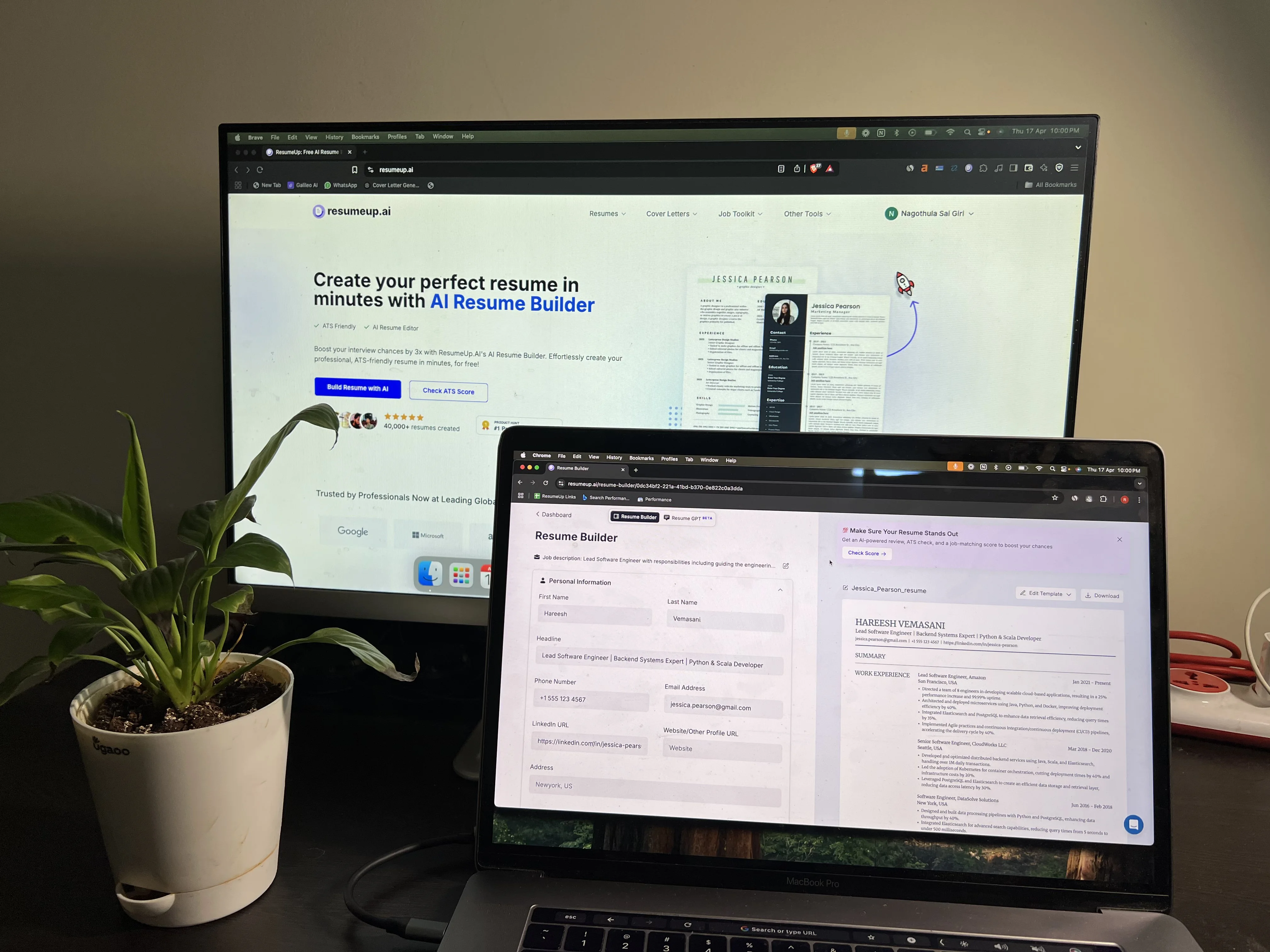
ResumeUp.AI is an AI-powered platform that makes job searching easier and more effective.
The problem it solves is very real: job applications are often filtered by ATS, recruiters skim in seconds, and most candidates don’t know what’s “missing” when they’re not getting interview calls. They keep applying more, but the real issue is usually the resume, with unclear impact, weak structure, missing keywords, or formatting that ATS can’t read properly.
ResumeUp.AI helps users:
- Build clean, ATS-friendly resumes with the right structure
- Tailor resumes to a job description without rewriting everything from scratch
- Use an ATS resume checker to spot missing skills and improve job match
- Generate a cover letter based on the resume and the job description
- Optimise LinkedIn profiles and track job applications in one place
- Autofill applications on major job boards to save time
What started as an AI-first resume builder has now expanded into a complete job search suite, helping job seekers at every step of their journey.
The idea came from a deeply personal experience. A close friend of mine, an extremely talented professional, kept getting his resume rejected by big tech companies’ ATS systems. He wasn’t even making it to the interview stage, not because he lacked skills, but because his resume wasn’t optimised for those filters. He didn’t even know ATS systems existed or how they worked.
We saw an opportunity to help job seekers compete on equal ground by showing them how to work with ATS systems without losing their voice or authenticity. So in 2024, my friend Rohith and I founded ResumeUp.AI to make the job search simpler, clearer, and more accessible.
How did you acquire your first 10 users, and what strategies worked?
We spent 3–4 months building a solid MVP and didn’t rush to launch publicly. Instead, I tested the product with a small group of friends and colleagues to gather early feedback and improve it.
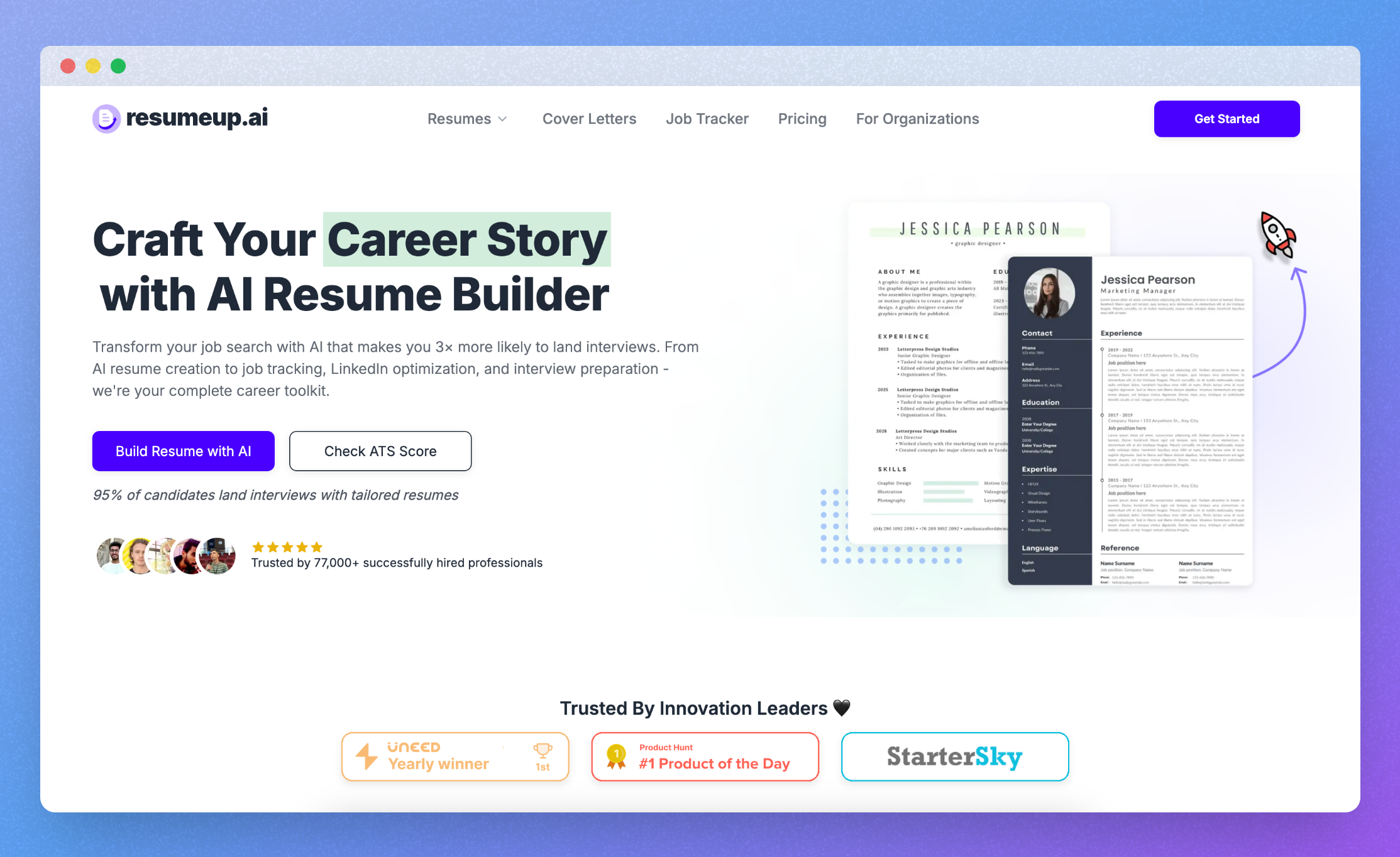
Once I felt confident, we decided to launch on Product Hunt. I spent about a month preparing - polishing the product, creating demo videos, and reaching out to friends and our network for support. That effort paid off when we hit #1 Product of the Day, which gave us strong early momentum and our first wave of users.
Just a few days after launch, we got our first paying customer. I still remember constantly refreshing our LemonSqueezy dashboard. When that first payment came through after about three days, it was a mix of relief and excitement - it confirmed that people were willing to pay for what we’d built.
What key metrics or user feedback confirmed that you were achieving product-market fit?
Several key metrics and feedback signals confirmed we were achieving product-market fit:
First, the willingness to pay was immediate. Getting our first paying customer within a couple of weeks of launch, followed by steady conversions, showed that people saw real value in what we built. Within two weeks of integrating payments, we had our first paying customer - clear proof the idea resonated.
Second, our AppSumo launch was a major validation point. We gained hundreds of customers in a short span and collected tons of feedback. The 4.6/5 average rating from around 73 reviews on AppSumo gave us confidence that users genuinely found value in the product.
Third, the organic growth metrics were telling. Users weren't just signing up - they were coming back, using the product repeatedly, and recommending it to others. We saw people creating multiple resumes, which meant they trusted our platform for their job search journey.

What steps did you take to validate that ResumeUp.ai was a good fit for your target customers?
Finding product-market fit wasn’t linear - it took several iterations and a lot of learning. I started by researching the hiring process, speaking with HR professionals, and understanding how ATS systems really work. This helped us see both sides: job seekers and recruiters.
Early on, we realized many job seekers didn’t even know ATS systems existed, so we had to educate users before selling to them. Another big lesson was that a great product alone isn’t enough. I spent too much time building and not enough time marketing, and had to push myself to learn sales and promotion.
We improved the product by listening closely to users - adjusting pricing to be more affordable and adding features like a job application tracker based directly on their feedback.
What distribution channels have been the most effective in reaching your audience, and how did you discover them?
The biggest early win was our Product Hunt launch, where a month of preparation helped us hit #1 Product of the Day, driving strong traction and credibility.
We also invested in SEO-driven content, which now brings steady organic traffic, and launched a lifetime deal on AppSumo to quickly gain users, feedback, and social proof. On top of that, we stayed active in communities like Reddit and IndieHackers, focusing on helping rather than hard selling.
Were there any distribution channels you tried that didn't yield the expected results?
Not everything worked, and those failures taught us a lot. Trying too many social platforms spread us thin and led to weak engagement. Cold email outreach also fell flat for us.
These lessons helped us focus our time and budget more carefully. We learned that organic growth, fewer channels, and genuine relationships worked far better than trying to be everywhere at once.
How does ResumeUp.ai stand out in the crowded resume/AI career tools space?
ResumeUp.AI stands out in several key ways:
1. AI-First Approach from Day One: We were one of the initial players in the resume space to take an AI-first approach. While others were adding AI as an afterthought, we built our entire platform around it from the ground up. Our AI doesn't just fill in templates - it understands job descriptions and suggests content that actually makes sense for each role.
2. Deep ATS Understanding: We spent months researching how ATS systems and recruiters actually review resumes. This research, combined with my experience as a hiring manager, is baked into every feature. Our ATS compatibility checker mimics real ATS systems, giving users actionable feedback on exactly what to fix.
3. Comprehensive Solution: We're not just a resume builder. We offer AI-powered resumes, content suggestions, a powerful editor, ATS compatibility checker, LinkedIn optimization, auto-fill job applications AND job application tracking - all in one platform. Users don't need to juggle multiple tools.
4. Exceptional Personalized Support: This consistently comes up in user feedback as a major differentiator. We genuinely care about helping people land jobs, not just selling software.
At the end of the day, we're not selling features - we're helping people get interviews and land jobs. That focus on outcomes over technology keeps us grounded and user-centric.
ResumeUp.ai ranked #1 and #5 on Product Hunt. How did this impact your growth?
First, the immediate traffic spike was great. Hitting #1 Product of the Day brought hundreds of visitors to our site in that launch week. But more importantly, it gave us instant credibility. That #1 badge became a trust signal we could leverage in all our marketing materials.
After the Product Hunt launch, we started getting featured in various newsletters and founder communities. It validated our product-market fit externally. Getting that level of upvotes and positive comments from the Product Hunt community - people who see hundreds of products - showed us we were onto something real. It boosted team morale and gave us confidence to push harder.
ResumeUP.AI doesn’t offer a freemium plan, why did you choose that model?
This was a very deliberate strategic decision.
We offer a free tier with 20 credits for using AI and creating resumes, enough to create 2 to 3 solid resumes. This lets users truly experience the value of our platform before committing. However, job seekers who are serious about their search typically need to create multiple tailored resumes for different roles, and that is where our paid plans make sense.
Freemium models in our space often lead to abuse, with people creating dozens of resumes they never use. This creates costs for us without generating value for users or the business. By having a credit-based free tier, we filter for serious users while remaining accessible.
What specific tools, software, or resources have been essential in growing ResumeUp.ai?
1. PostHog: For product analytics and understanding user behavior.
2. Intercom: For customer support and user engagement.
3. Ahrefs: For SEO.
What advice would you give founders trying to find the right distribution channel for their product?
Focus on Channels That Scale With Effort, Not Just Money: Paid ads can work, but they require continuous spending. SEO, content creation, and community building take time upfront but compound over time. For bootstrapped founders, channels that scale with effort are often more sustainable.
Any promotions you would like to add for Founderoo readers?
30% Discount on all the plans: FOUNDEROO30
What motivates you to keep building ResumeUp.ai, especially through tough times?
Several things keep me motivated through the tough times:
1. The Mission: Knowing that we're genuinely helping people land jobs and change their lives is incredibly powerful. When we get messages from users who secured interviews or job offers thanks to our platform, it makes every challenge worthwhile. We're not just building software - we're helping people support their families and achieve their career goals.
2. Seeing Progress: Even when growth feels slow, looking back at where we started - from zero to 300+ paying customers, $4K MRR, 30K monthly visitors - shows that we're building something real. Small wins compound.
3. My Co-founder and Team: Having Rohith as my co-founder and our small but passionate team makes the journey less lonely.
4. Learning and Growth: Every challenge teaches me something new. Whether it's marketing, sales, or product development, I'm constantly growing. That personal development journey is fulfilling in itself.
Are there any guiding principles or quotes you live by?
"Tech alone isn't the hard part—distribution is"
This insight from the StarterSky article resonates deeply. You can build the best product in the world, but if nobody knows about it, it doesn't matter. Learn marketing early.


